
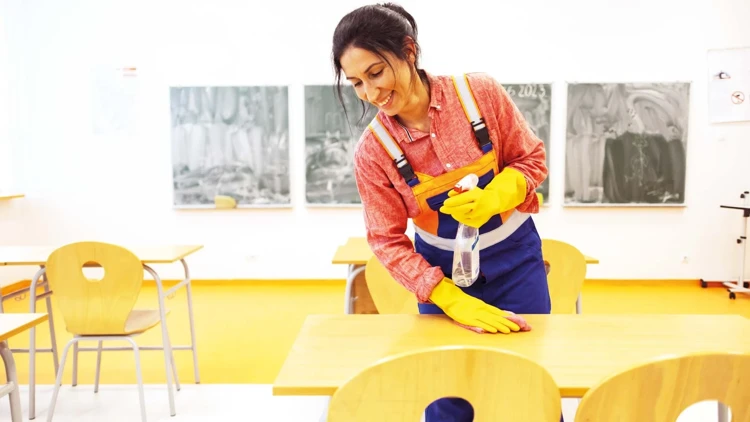

Ask most school business managers what their cleaning contract actually covers, and you’ll get a slightly different answer every time. Some assume it’s just mopping floors and emptying bins after the bell rings. Others discover, usually the hard way, that their contract never included the air conditioning vents, the sports equipment room, or the canteen’s grease traps. Knowing exactly what a proper school cleaning service should cover isn’t just about ticking boxes, it’s about understanding where the gaps usually sit, and making sure nothing important falls through them.
The Daily Essentials
At its core, a school cleaning service should cover the areas every student and staff member passes through each day. That means classrooms, corridors, staff rooms, toilets and communal areas, cleaned to a schedule that matches how heavily each space is used. Toilets and high-touch surfaces, door handles, light switches, taps and shared equipment, typically need daily attention, while general classroom cleaning is usually done once a day outside school hours.
Bin removal, floor care and surface wiping are the obvious inclusions, but a genuinely thorough service also covers less visible areas: skirting boards, window sills, and the corners where dust and allergens tend to settle unnoticed. These details rarely show up in a quick walk-through, but they add up over a term.
It’s also worth clarifying who’s responsible for staff-only areas like offices, staff rooms and meeting spaces. These are sometimes left out of a scope by default, on the assumption that staff will tidy up after themselves, but they see just as much daily traffic as any classroom and deserve the same standard of attention.
Where Indoor Air Quality Fits In
Cleaning isn’t just about surfaces, it plays a role in the air students and staff actually breathe. Research from the Burnet Institute notes that schools can see improved academic outcomes and lower illness-related absenteeism when indoor air quality is properly managed, alongside benefits for students with asthma. Dust, allergens and residue from cleaning products all affect the air in a naturally ventilated classroom, so the products and methods used matter as much as the frequency of cleaning.
A comprehensive service should include vacuuming with proper filtration, regular dusting of vents and surfaces, and the use of low-residue cleaning products, particularly in classrooms and libraries where students spend hours in one space. It’s a detail that’s easy to overlook in a contract, but one that has a real effect on comfort and health across a term.
Ventilation habits matter here too. Many Gold Coast classrooms rely on natural airflow through windows and doors, which means dust and product residue can linger longer than they would in a mechanically ventilated space. A cleaning provider that understands this will time certain tasks, like dusting or product-heavy jobs, for periods when a room can be properly aired out afterwards.
Exterior and Structural Cleaning
Everything outside the classroom door matters too. Proper school pressure cleaning on the Gold Coast deals with the build-up that indoor cleaning never touches, grime on covered walkways, mould in shaded breezeways, and grease around canteen and undercover eating areas. Left untreated, these surfaces become slippery, unsightly, and in humid Gold Coast conditions, a genuine mould risk.
A well-rounded contract should specify how often exterior areas are treated, not leave it as an afterthought. Walkways, undercover areas, bike racks and building exteriors all need a place on the schedule, even if it’s quarterly rather than weekly.
It’s easy to underestimate how much wear these areas take. Hundreds of students moving through the same covered walkway every day, combined with Gold Coast humidity and rain, creates ideal conditions for algae and mould to take hold within weeks of a clean, not months. A schedule built around the actual climate, rather than a generic template, tends to hold up far better.
Specialist and Seasonal Cleaning
Beyond the daily and weekly routine, a good school cleaning service should include specialist work that doesn’t fit neatly into a standard clean. Carpet and upholstery cleaning, hard floor stripping and sealing, and window cleaning usually sit outside the everyday schedule but should still be planned into the calendar, ideally during school holidays, when classrooms and shared spaces can be fully reset without disrupting lessons.
Canteens and food preparation areas deserve particular attention, since they’re subject to stricter hygiene expectations than a standard classroom. A cleaning provider working in a school should understand food-safety-adjacent cleaning, not just general commercial cleaning, and be able to demonstrate how their canteen routine differs from their classroom routine.
Sporting facilities and change rooms are another area that’s easy to underweight in a standard contract. Sweaty equipment, shared mats and communal showers create conditions that spread bacteria quickly if they’re only cleaned at the same frequency as the rest of the school. These spaces generally warrant a more frequent, targeted routine, particularly during winter sports seasons when usage is highest.
What to Ask Before Signing a Contract
The clearest way to avoid gaps is to ask a provider to walk through their scope area by area before agreeing to anything. A conversation with an experienced Gold Coast commercial cleaning company should cover exactly which spaces are included, how often each is cleaned, what products are used, and how the schedule adjusts during flu season or after an outbreak. If a provider can’t answer these questions clearly, it’s worth asking why.
A school cleaning contract should never be a mystery. The best providers document their scope in detail, adjust it as the school’s needs change, and treat cleaning as an ongoing partnership rather than a fixed, one-size-fits-all service. Getting this right from the start saves a lot of frustration, and a lot of missed spots, down the track.
Frequently Asked Questions
What areas should a school cleaning contract cover?
Classrooms, corridors, toilets, staff rooms, canteens, and exterior areas like walkways and breezeways should all be specified, along with how often each is cleaned.
Does school cleaning include air quality management?
A thorough service accounts for air quality through filtered vacuuming, dust control and low-residue products, since these directly affect classroom air, not just visible cleanliness.
How often should exterior areas be pressure cleaned?
This depends on the school’s location and conditions, but quarterly treatment of walkways, breezeways and undercover areas is a reasonable starting point in humid climates.
Is canteen cleaning different from classroom cleaning?
Yes. Canteens and food preparation areas need stricter hygiene routines and often specific products, closer to food-service standards than general classroom cleaning.
When should specialist cleaning like carpets or windows happen?
School holidays are ideal, since these bigger jobs can be completed without disrupting lessons, giving the school a clean reset before the next term begins.