

Your Office Has Stopped Working for You
The carpet is dilapidated, the meeting rooms are always booked, and half the desks sit empty on Fridays.
Perhaps your staff has either grown or shrunk, or your workflow has shifted considerably. Either way, your office surroundings do not align with your staff size or work style.
Many managers and business owners in Australia face a dilemma: do they refurbish or install a full office fitout? Both are transformative solutions, but the right choice depends on your budget, lease, timeline, and long-term vision. If you’re considering either option, but don’t know where to start, we, as trusted Gold Coast office fitout professionals, can help.
This blog discusses the differences between a refurbishment and a full office fitout, helping you make informed decisions and achieve a safe, collaborative work environment.
Refurbishment vs Full Fitout: What’s the Difference?
Knowing the difference between a refurbishment and a fitout helps you choose the best long-term solution for your office and get a strong return on investment.
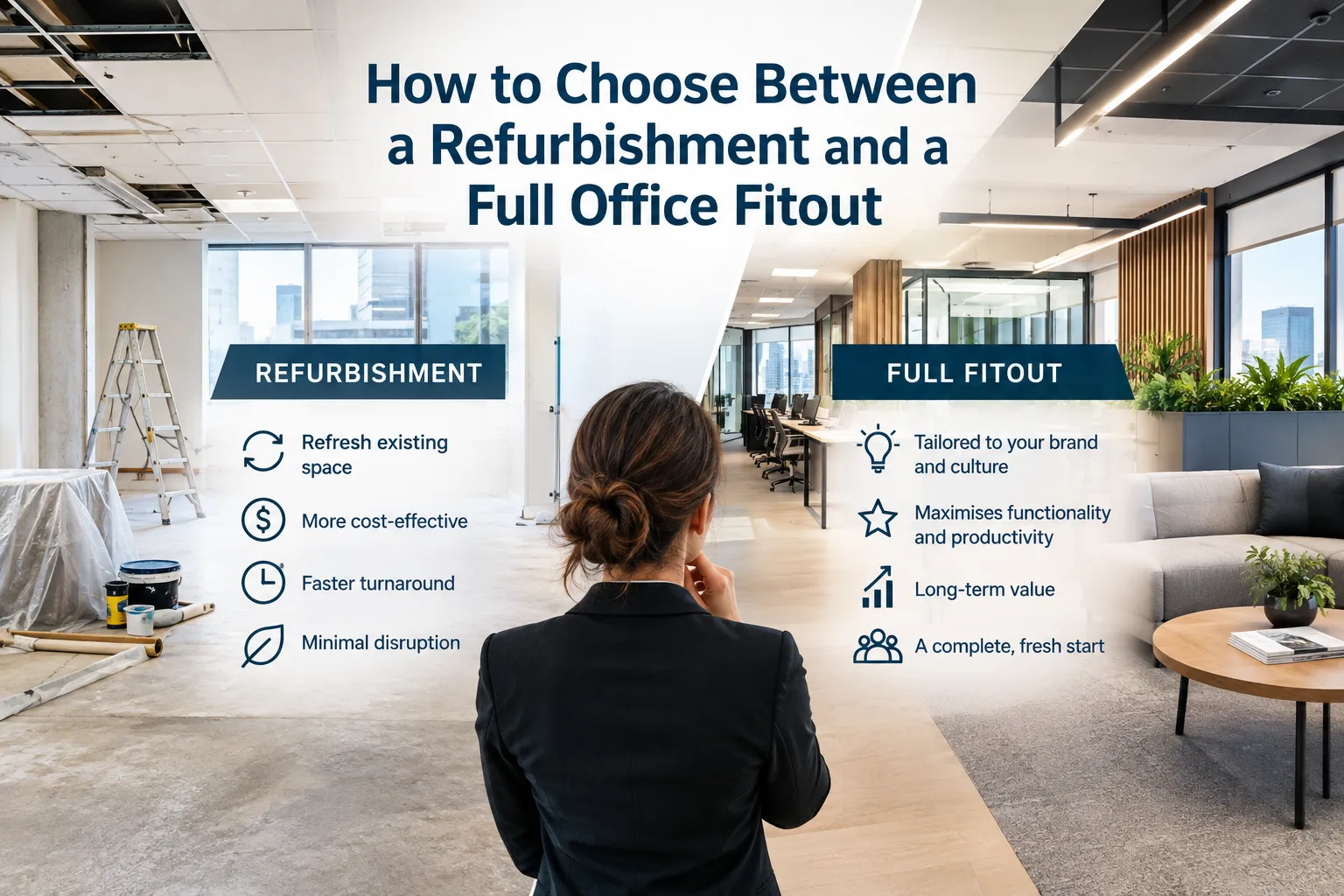
A refurbishment updates your existing office without changing its basic layout. Think new carpet, fresh paint, better lighting, updated furniture, a modern kitchen, or several extra meeting rooms. The walls, ceilings, power and air conditioning usually remain in their existing positions.
On the other hand, a full fitout starts with an empty space and builds everything to suit you, including new walls and ceilings, rewired power and data, new air conditioning layouts, kitchens, bathrooms, joinery, and furniture. It’s the option most businesses in Southeast Queensland choose when moving into a new tenancy or when an existing office needs to be completely rethought.
In simple terms, a refurbishment improves how your office looks and feels. A full fitout changes how it works. A reputable commercial fitout company can help you determine the better solution for your workspace and deliver long-term results.
When a Refurbishment Makes Sense
A refurbishment is usually the smarter choice when your office’s basic layout is still functional. Consider it if:
- Your layout still works: Teams work in strategic locations, office space is adequate, and staff can focus on high-priority tasks.
- Your lease has a few years left: Spending heavily on a space you might leave in two years rarely returns long-term dividends.
- Your budget is limited: A refurbishment costs far less than a full fitout, and the money goes into the things people see and use every day.
- You can’t afford much downtime: Many commercial outfit companies refurbish offices in stages, after hours, or on weekends, ensuring uninterrupted operations and minimal downtime.
- Outdated finishes are the norm: Worn carpets, dated colours, and poor lighting can make an established office feel neglected. Fixing them often makes a bigger difference than you’d expect.
A well-planned refurbishment can lift staff morale, impress clients and extend the life of your space for years. Investing in one can provide a high level of satisfaction, especially when done by a highly skilled contractor.
When a Full Fitout Is the Better Choice
Sometimes, a coat of paint simply won’t fix the problem. A full fitout is worth considering when:
- You’re moving into a new space: A new tenancy almost always needs a proper fitout that aligns with your business.
- Your work processes have changed: If your business has adopted a hybrid setup, you may need fewer desks and more meeting rooms, quiet rooms, and shared spaces. This strategy usually requires moving walls, power, and data connections.
- You’ve signed a long-term lease: With five or more years ahead, the cost of a full fitout is spread over a longer period, and you’ll get more value from it.
- The services are outdated: Ageing air conditioning, poor lighting, insufficient power points, or patchy internet affect comfort and productivity every day.
- Your space must comply with current building rules: Older offices may need upgrades for accessibility, fire safety, or energy use, which are easier to handle as part of a full fitout.
Although a full fitout takes longer to plan and build, it gives you a workplace designed around how your business currently operates and its long-term goals.
Quality Space Is in Demand
The office market itself can help you decide. The Property Council of Australia’s latest Office Market Report found national office vacancy reached 16.1% in July 2026, with businesses continuing to favour higher-quality buildings over older stock (Property Council of Australia, 2026).
For tenants, that matters in two ways.
- First, with plenty of empty space around, you may be able to negotiate a landlord contribution towards your fitout or refurbishment, especially if you’re signing a longer lease.
- Second, these findings indicate that well-presented, comfortable offices are what businesses and their staff expect. A tired space can make it harder to attract and keep good people.
Questions to Ask Before You Decide
Before you hire a reputable contractor, sit down with your leadership team and work through these questions:
- How long will we stay here? Check your lease end date, renewal options and any obligation to return the space to its original state when you leave.
- What isn’t working today? Ask your staff about layout and space issues. Their answers will show whether you have a looks problem or a layout problem.
- How will our team adapt? Plan for headcount, hybrid work, and new equipment over the next five years.
- What’s our real budget? Include furniture, technology, approvals, moving costs, and a buffer for surprises.
- How much disruption can we handle? Decide whether you can work around builders, move out temporarily, or need work done after hours.
- Will the landlord contribute? Talk to your landlord or agent early. Incentives are often tied to lease length.
An experienced fitout company can assess your space, explain the costs of each option and give you a realistic timeline. Many offer a free first consultation.
There’s no single right answer. If your office still works but looks tired, a refurbishment delivers great value. If your business’s work style has changed or you’re settling in for the long haul, a full fitout will serve you better in the long term. Start with honest answers to the questions above, and the right choice usually becomes clear.
If you’re considering a refurbishment or a full office fitout, Airey Building Group can help you determine the better option for your business. Contact us today to discuss your vision, experience transformative fitout solutions, and give your office a fresh new look.
Frequently Asked Questions (FAQs)
How long does an office refurbishment and a full fitout take?
A simple refurbishment can take a few weeks, depending on the size of the space. A full fitout usually takes a few months, including design, approvals and construction. Your fitout company should give you a written timeline before work starts.
Can we stay in the office during a refurbishment?
Many refurbishments are done in stages, after hours, or over weekends, so your team can keep working. A full fitout usually means relocating while work is underway, unless the space is large enough to complete in sections.
Do I need approval from my landlord?
Most leases require landlord approval for any building work, and some changes also need council or building approvals. Talk to your landlord early and get approvals in writing before any work begins.
Will my landlord pay for the fitout?
Landlords may offer a contribution or rent-free period, particularly for longer leases or when there’s plenty of vacant space nearby. Ask your agent or landlord what incentives are available before you sign or renew your lease.
What does ‘make good’ mean in a lease?
It’s a lease clause that may require you to return the space to its original condition when you leave. Removing a fitout can be costly, so check this clause before deciding how much to change, and factor it into your budget. We recommend discussing this clause with your landlord before work begins to prevent confusion and costly mistakes.