
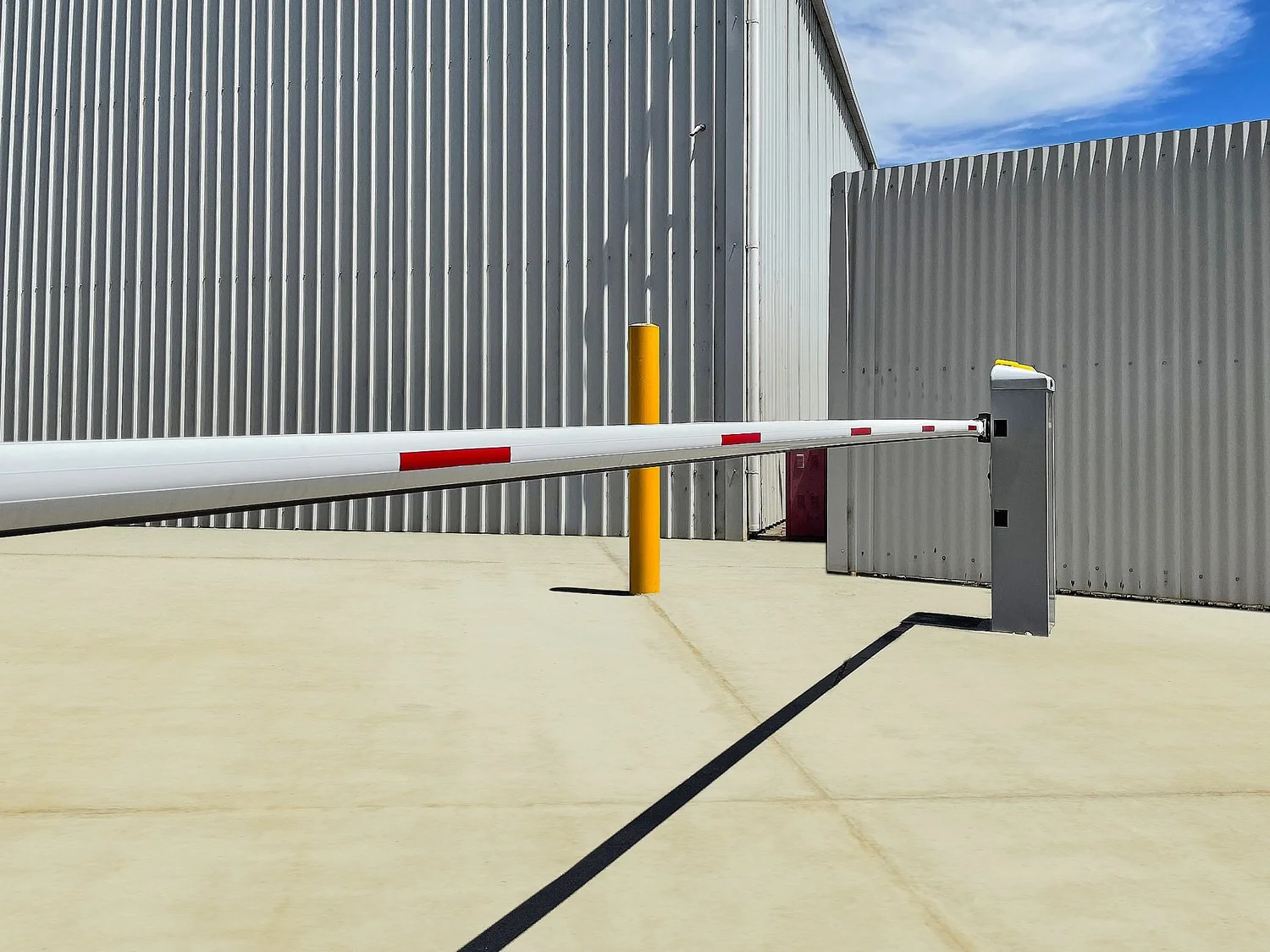

Securing a car park, warehouse, construction site or gated estate always comes down to one early decision: manual boom gate or automatic. Both control vehicle access, and on paper they look interchangeable. In practice, they pull your budget, your rosters and your daily traffic flow in completely different directions. Here’s how the two compare, and what each one actually costs once the invoice is settled.
How Manual and Automatic Boom Gates Actually Work
A manual boom gate is operated by hand. Someone lifts the arm, waves the vehicle through, then lowers the arm again. There is no motor, no wiring and very few moving parts, which makes it about as mechanically simple as site security gets.
An automatic boom gate runs on power, usually an electric or hydraulic motor, and opens on command. That command might come from a remote, keypad, swipe card, number plate camera or an intercom. Nobody needs to touch the gate for it to do its job.
That single difference, whether a person is required at the barrier, drives almost every pro, con and dollar figure that follows. Keep it in mind as you weigh up the two options because most of the trade-offs trace straight back to it.
Manual Boom Gates: The Upsides and the Trade-Offs
Manual gates win on cost and simplicity. With no motor, control panel or cabling to install, these Brisbane boom gates are the cheaper option from day one, and fewer parts means fewer things that can fail. When something does go wrong, a worn spring or hinge is usually a quick and inexpensive repair.
They also work without power, which suits remote sites, temporary compounds and anywhere the electrical supply is unreliable. Operation is obvious enough that casual or rotating staff pick it up in seconds, with no software or access system to learn.
The trade-off is labour. Somebody has to be there every single time, which usually means rostering staff or engaging a security guard. On sites with steady vehicle movement, that manual step creates queues and slows the whole operation down.
Staff comfort takes a hit as well. Whoever works the gate does it in the rain, the heat and the dark, which wears thin quickly. You also lose visibility because without an electronic system, there is no automatic log of who entered, who left, or when.
What You Gain (and Give Up) With Automatic Boom Gates
Brisbane automatic boom gates take the person out of the equation. Once installed, the system runs itself, and your labour goes back to work that genuinely needs a human. Vehicles move through faster too, which matters enormously at busy car parks, depots and loading zones where a 30-second delay per vehicle turns into a queue on the street.
Security is where automation pulls clearly ahead. These gates connect to access cards, number plate recognition and CCTV, so you hold a proper record of every entry and exit rather than a rough guess. The gate also behaves identically every time, regardless of who is on shift.
What you give up is upfront affordability and mechanical simplicity. You are paying for the motor, control system, sensors and installation, not just a barrier arm. Most systems need mains power, although solar options exist for off-grid sites. Installation calls for a qualified technician rather than a general handyman, which adds to the initial outlay.
Maintenance is heavier as well. Motors, sensors and electronics all require servicing, and repairs tend to be more involved and more expensive than patching up a manual gate.
Upfront Price vs Long-Term Spend
Manual boom gates are cheaper to buy and install, but the catch presents itself later. Paying someone to operate the gate, even a small slice of a security guard’s shift, adds up quickly across a year, and the gate itself will likely stay in service for a decade or more.
Automatic gates flip that equation. The higher cost is largely a one-off, and from there, your ongoing spend covers maintenance and the occasional replacement part rather than a recurring wage. For sites with steady vehicle traffic, most businesses find automatic boom gates pay for themselves in saved labour within a couple of years.
The right call comes down to traffic volume, existing staffing, and how long you plan to use the site. A short-term construction project rarely justifies the investment in automation, while a permanent car park or industrial site almost always does.
Wider demand backs that up. The market analysis published by Market Research Intellect valued the global automatic gate systems market at USD 11.3 billion in 2023 and projected it to reach USD 19.6 billion by 2031, driven largely by growing security needs across commercial, industrial and residential sites. That trend matches what we see on the ground, with more businesses moving away from manual operation as their sites grow and their security requirements become more complex.
Match the Gate to the Way Your Site Runs
There is no universally better option, only the one that suits your site. Before you commit, work through these questions:
- How many vehicles move through your entrance on a typical day?
- Have you got staff on site who could work a gate, or would that mean hiring someone?
- Will this site still be operating in 10 years or more, or is it temporary?
- Do you need a record of who came and went, whether for compliance, insurance or security?
- Can your budget carry a higher one-off cost, or does it favour a smaller upfront spend?
Answer those honestly, and the choice usually makes itself. If you are still weighing up which system fits, our team at Create Security can walk you through the options and put together a straightforward quote based on your traffic, layout and budget.
Common Questions About Boom Gates
Can a manual boom gate be upgraded to automatic later?
Some manual gate frames can be retrofitted with a motor and control system. It depends on the model, so check compatibility with your supplier before purchasing.
How long does an automatic boom gate typically last?
Expect somewhere between 10 and 15 years from a serviced system. How much traffic it handles, how exposed it is to the weather, and how consistently it gets maintained will push that figure up or down.
Do automatic boom gates work during a power outage?
Nearly all automatic boom gates do, through either a battery backup or a manual override that lets you raise the arm by hand. Worth confirming before you buy, especially if your site runs around the clock.
Are automatic boom gates safe for pedestrians?
Yes, provided the safety gear is fitted. Photoelectric sensors and safety edges stop the arm the moment they detect something in the way. Ask your supplier to confirm the model meets the relevant Australian safety standards.
Which option is better for a small business car park?
Manual Brisbane car park boom gates often can do the job on quiet, budget-conscious sites. Once you have regular turnover or people needing access after hours, an automatic system tends to work out cheaper over its lifetime.