
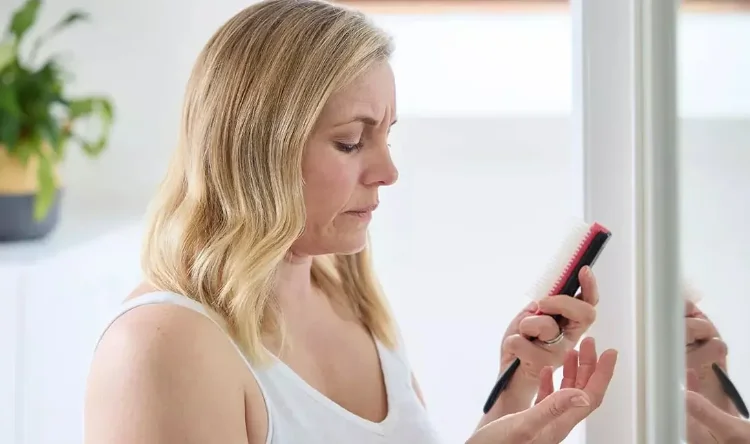

Hair changes are often one of the quieter changes women notice during midlife. While menopause is often linked to sleep disruption, hot flushes, and mood changes, many women also notice changes in hair thickness and increased shedding. And, the uncertainty lies in knowing whether what they are experiencing is part of normal hair shedding or a sign of menopausal hair loss.
Let’s look at how hair normally grows and how menopause can interfere with that process, so you can recognise when hormonal changes may be influencing your hair rather than normal, day-to-day shedding.
What Is Happening Beneath the Scalp?
Each strand of hair follows a repeating growth cycle that typically lasts between two and seven years. This cycle has four main phases:
- Anagen is the growth phase, when hair actively grows from the follicle.
- Catagen is a short transition phase where growth slows and the follicle begins to shrink.
- Telogen is the resting phase, when the hair remains in place but is no longer growing.
- Exogen is the shedding phase, when the hair is released and eventually replaced by new growth.
Most scalp hairs are in the anagen phase.
How Menopause Influences Hair Thickness and Growth
Hair growth does slow with age, but hormonal changes during menopause can push more hairs into the resting and shedding phases. Oestrogen plays a role in supporting the hair growth cycle, and as levels fall, hair may spend less time in the growth phase and move more quickly into resting and shedding.
For some women, this shows up as a gradual loss of volume. For others, thinning is more noticeable, especially when genetics, ongoing stress, or lifestyle factors are also at play. The pattern and pace of hair change can vary widely, which is why menopausal hair loss does not look the same for everyone.
Daily Hair Fall or Ongoing Thinning?
Shedding is a normal part of the hair cycle. Most people lose around 50 to 100 hair strands per day without any visible thinning. This type of shedding usually occurs evenly across the scalp and does not change the overall density of the hair.
Temporary increases in shedding can occur after illness, surgery, weight loss, or periods of stress. This is often referred to as telogen effluvium, which is a short-term shift where more hairs than usual move into the shedding phase. In these cases, regrowth usually follows once the underlying trigger settles.
Signs Hair Changes May Be Influenced by Hormone Changes
Menopausal hair loss differs from normal shedding because it affects how well the hair follicles return to the growth phase. Rather than shedding evenly, women in perimenopause often notice gradual thinning over time. Common signs include:
- Thinning spread across the scalp rather than limited to one area
- A widening hair part that becomes more noticeable over months
- A ponytail that feels thinner or less dense
Unlike temporary shedding, menopausal hair loss can persist into postmenopause if the underlying hormonal changes are not addressed.
Age and Timing as Important Clues
Most women enter perimenopause between the ages of 45 and 55, with menopause occurring at an average age of 52. Hair thinning that begins around this stage, particularly when it appears alongside other menopausal symptoms, may suggest a hormonal influence. On the other hand, hair loss that starts suddenly or at a much younger age should be assessed individually rather than assumed to be menopause-related.
Typical Patterns of Menopausal Hair Loss
Menopausal hair loss usually develops gradually. In fact, early signs are often subtle and easy to overlook. With time, you may begin to notice:
- A progressively wider hair part
- Thinning across the crown and top of the scalp
- Less volume when styling or tying hair back
- Mild recession around the temples
Seeing extra hair in the shower drain or on clothing can be distressing, but the pattern and persistence of thinning are often more informative than a single episode of increased shedding.
Other Factors That Can Affect Hair Changes at Midlife
Not all hair changes during midlife are driven by menopause. Factors such as stopping hormonal contraception, recent childbirth, surgery, and ongoing stress can also affect the hair cycle. In these situations, increased shedding is often temporary and improves over time.
Ways Hair Loss Is Managed
Distinguishing between temporary shedding and longer-term hair loss is important, as the approach can differ depending on the cause. Once you have confirmed that your hair changes are related to menopause, it helps to know that there is no single solution. It’s best to talk to a Gold Coast menopausal specialist for a range of management options, depending on the underlying factors.
First, hair-thickening shampoos cannot stimulate new growth, but they can help reduce breakage and improve the appearance and texture of thinning hair. Some formulations aim to support hair density and scalp health.
Hormonal changes during menopause can also increase susceptibility to nutrient deficiencies.
In selected cases, the doctor may recommend vitamins or supplements. These should always be taken under medical guidance, as excess supplementation can interfere with hair follicles and may affect overall health.
Alongside this, stress management is another important consideration. Menopause can be a demanding stage of life, and ongoing stress may worsen hair changes. Exercise, balanced nutrition, and relaxation strategies may help reduce the effects of stress.
Finally, medical options such as low-level laser therapy, platelet-rich plasma therapy, hair transplant procedures, or hormone replacement therapy may be discussed in consultation with a qualified practitioner, depending on individual circumstances.
Emotional Wellbeing and Hair Loss
Hair loss can affect confidence and self-image, particularly when it occurs during a time of other physical and emotional changes. For some women, understanding the hair growth cycle and knowing what to expect can reduce anxiety. For others, additional psychological support may be a valuable part of managing the experience, especially if hair changes are affecting social or emotional wellbeing.
When It Is Worth Getting Checked
If you are noticing progressive thinning, a widening hair part, or hair loss that continues over time, it is worth seeking medical advice. Hair changes can be linked to menopause, underlying health conditions, or medication use, so proper assessment matters.
At Her Medical, we take a holistic approach to menopausal care. We work with women to assess hormonal health, identify contributing factors to hair loss, and develop personalised plans that support wellbeing through menopause and beyond.