

The best kind of entertainment during the sweltering summer months is a swimming pool. Nothing compares to the joy of plunging into a crystal clear pool, whether you’re trying to beat the heat or are just relaxing poolside. However, regular scrubbing is insufficient to ensure that a pool is kept clean. Pool chemical balance is one of the key components of pool maintenance.
The Significance of Balanced Pool Chemistry
A balanced pool chemistry not only provides swimmers with safe and healthful swimming conditions, but it also safeguards the pool’s infrastructure from harm brought on by corrosive or scaling water. For the health and safety of swimmers, a pool’s chemistry must be properly balanced. Unhealthy bacteria and viruses that can lead to a variety of unpleasant ailments, including as ear infections, rashes, and even respiratory issues, can be found in a pool with an unbalanced chemistry. The water in the pool can be kept clear and free of these dangerous organisms by routinely pool cleaning, checking and adjusting the chemical levels. This will make swimming a joyful and healthful pastime for everyone.
The infrastructure of the pool must be kept in good pool chemical balance to avoid harm from water that is corrosive or scale-forming. A pool’s improper chemical balance can result in a number of problems, such as cloudy water, scaling, and equipment and wall corrosion.
These problems may not only be ugly but also expensive to fix. However, pool owners may considerably lower the danger of harm from strong chemicals and guarantee that their pool stays in excellent shape by maintaining balanced chemical levels.
Maintaining a welcoming pool atmosphere requires crystal-clear water. A hazy pool is far less attractive than one that is sparkling clean and clear. Swimming enthusiasts may avoid pools with hazy water due to unbalanced pool chemistry. However, since crystal-clear water results from a healthy chemical balance, routine chemical testing and balancing is essential to maintaining a stunning, inviting pool.
The Key Components of Pool Chemistry
Chlorine
As your pool’s main sanitizer, this potent chemical is essential. It effectively gets rid of dangerous germs and pollutants. Chlorine reduces the danger of waterborne infections by oxidising and eliminating organic waste, including germs and perspiration. However, it’s essential to keep your pool’s chlorine level at the proper level. Too little and your pool may develop into a haven for dangerous bacteria; too much and it might irritate your skin and eyes. To be sure you’re properly dosing your pool, monitor your chlorine levels and utilise test strips.
pH Level
This gauges the acidity or alkalinity of the water in your pool. To maximise chlorine’s efficiency, the optimal range must be maintained, which lies between 7.2 and 7.8. Your chlorine won’t be able to function properly and may irritate swimmers’ eyes and skin if your pH is too low. However, if your pH is too high, your chlorine will lose some of its effectiveness, which could lead to scaling and hazy water.
Total Alkalinity (TA)
TA is a gauge of a pool’s resistance to pH variations. It essentially serves as a buffer, stabilising the chemistry of the water. The pH of your pool might change drastically if your TA is too low, making it difficult to keep it within the appropriate range. On the other hand, if your TA is too high, it could be quite challenging to properly change your pH or total chlorine levels.
Calcium Hardness
This determines the level of calcium in your pool’s water and has an impact on water balance. If your calcium hardness is too low, it can harm surfaces like tiles and grout and contribute to metal corrosion. If it’s too high, scaling may result, harming pool equipment and clogging filters. Therefore, it’s crucial to keep your pool’s calcium hardness level at the proper level, which should be 200–400 parts per million (PPM).
Common Mistakes Pool Owners Make and How to Avoid Them
As pool owners, we want to take a cool dip on a hot day in the clear water. But occasionally, we commit simple errors that can cause issues and demand expensive repairs in the future.
The first error is skipping routine testing. Testing the water is simple to forget or put off, especially when the pool appears clear and clean. However, even if the water seems to be in good condition, there could be underlying problems that have an impact on swimmers’ health and the pool’s machinery. There are numerous accounts of pool owners who had issues including algae blooms, equipment damage, and expensive repairs because of uneven testing.
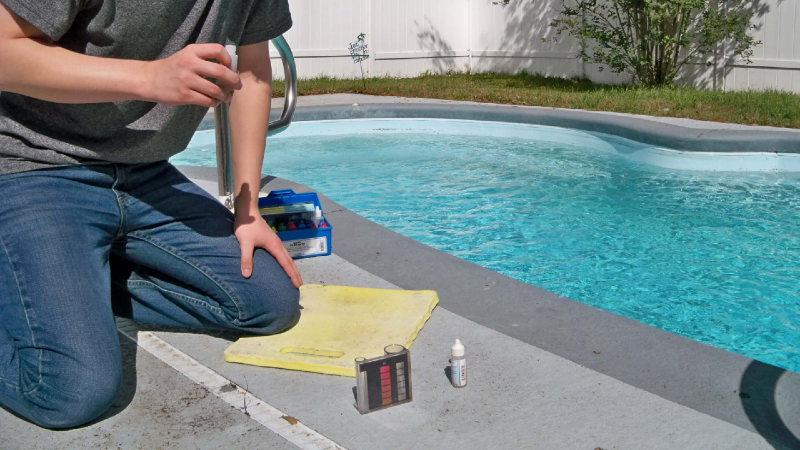
Make it a practise to test the water at least once per week, or more regularly during periods of high usage or warm weather, to prevent making this error. Purchase a trustworthy testing kit, or bring a sample of your pool’s water to a lab for analysis. You can then change the chemical concentrations to keep your water clean and clear.
Over-chlorination is another typical error. Chlorine is a necessary sanitizer that eliminates bacteria and other dangerous organisms, but too much of it can hurt swimmers’ skin and eyes and give off a strong chemical odour. Over-chlorination frequently causes skin irritation, redness, and itching.
Be aware of the recommended chlorine levels and check them frequently to prevent making this error. Add more or less chlorine to the solution as needed to adjust the levels. You can also use sanitizers that are less damaging to the skin and eyes, such bromine.
Another typical error is to disregard pH and alkalinity values. Total alkalinity (TA) assesses the water’s capacity to withstand pH variations, whereas pH assesses the water’s acidity or alkalinity. Unbalanced pH and TA levels can cause equipment damage, murky water, and decreased sanitizer effectiveness.
Test the pH and TA values, and make the necessary adjustments to prevent this error. While TA should be between 80 and 120 ppm, the optimal pH range is between 7.2 and 7.8. To get the levels into the appropriate range and keep them there, use pH and TA balancers.
Another typical error is to ignore calcium hardness. The amount of dissolved calcium in the water is measured by calcium hardness, which has an impact on the water’s capacity to dissolve other minerals and substances. Low or excessive calcium levels can harm the pool’s surface and machinery as well as the skin and hair of swimmers.
Test the calcium levels frequently and modify them as necessary to prevent this error. 200 to 400 ppm is the optimal range for calcium hardness.To get the levels within the suggested range, use a calcium hardness increaser or decreaser.
Achieving and Maintaining the Ideal Chemical Balance
To ensure the safety and enjoyment of your pool for all swimmers, the proper chemical balance must be achieved and maintained. In addition to looking spotless, a balanced pool aids in avoiding issues like algae growth, hazy water, and eye irritation.
Regular water testing is the first step to achieving a balanced pool. Maintaining a healthy pool requires making an investment in a dependable test kit and setting up a regular testing routine. You can keep track of important pool components like calcium hardness, pH, alkalinity, and chlorine with the use of a test kit. It will be easier to prevent pool problems from developing and to guarantee a trouble-free swimming season if you regularly test your pool’s water and keep it balanced.
The following crucial stage is proper management of chlorine. Chlorine is essential for keeping pools clean and avoiding the formation of microorganisms that could cause sickness. The market offers a variety of chlorine products, including tablets, granules, and liquid. Maintaining the optimum chlorine levels might occasionally feel overwhelming with the number of options available. However, if you continuously monitor the levels and adhere to the manufacturer’s recommendations, you’ll rapidly become an expert. It’s also crucial to pick the proper product for your pool because they all have distinct features and advantages.
The following crucial elements in keeping a healthy pool are pH and alkalinity changes. Alkalinity evaluates the water’s resistance to pH variations, while pH measures the acidity or basicity of the pool’s water. It’s important to maintain a balance between these two factors because an imbalanced pH can irritate the skin and high alkalinity can generate hazy water. You can employ substances like soda ash or muriatic acid to modify pH. Baking soda and sodium bicarbonate can also be used to control alkalinity. It’s critical to carefully follow the directions and avoid excessive adjustment, which can cause more issues in the future.
Keeping calcium hardness under control can assist guarantee the pools equipment in your pool lasts a long time. Scale formation brought on by high calcium levels can choke pipes and harm mechanical components. This problem can be resolved by dilution with fresh water or calcium hardness boosters. Nevertheless, controlling calcium levels can be challenging because they depend on your location and the type of pool liner you have.
Conclusion
Clear and safe swimming water depends on maintaining a balanced water chemistry. All summer long, you may maintain a fun and healthy swimming pool by learning the essential elements of pool chemistry, avoiding common mistakes, and paying attention to the advice provided in this article.